
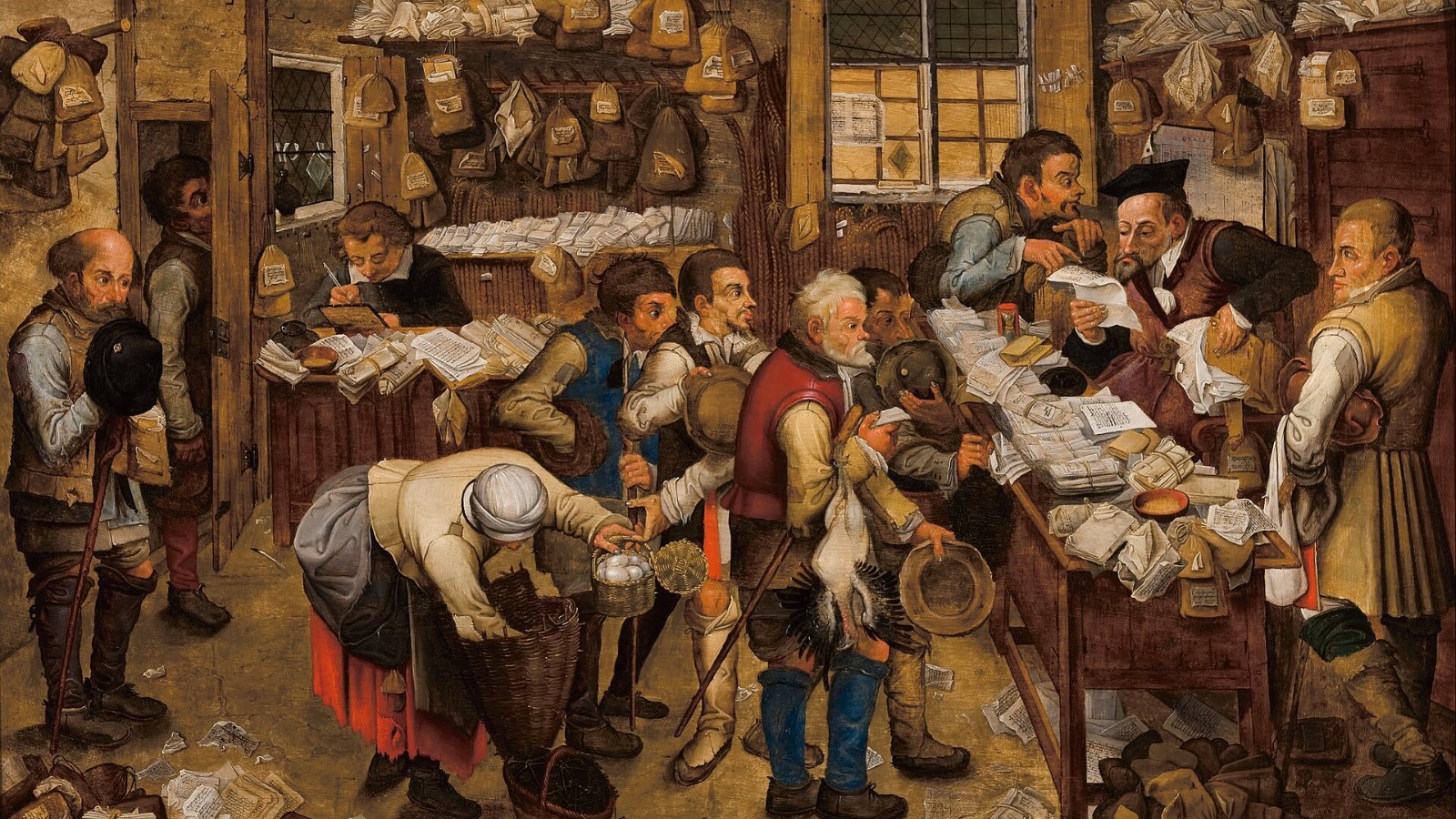
Illustration: Pieter Brueghel the Younger, The Tax Collector’s Office (c. 1615), public domain.
TEXTS
Article 4 A of the CGI provides:
« Les personnes qui ont en France leur domicile fiscal sont passibles de l’impôt sur le revenu en raison de l’ensemble de leurs revenus. Celles dont le domicile fiscal est situé hors de France sont passibles de cet impôt en raison de leurs seuls revenus de source française. »
(Persons whose tax domicile is in France are liable to income tax on their worldwide income. Those whose tax domicile is outside France are liable only on their French-source income.)
Article 4 B of the CGI adds that a person is domiciled in France for tax purposes if he or she has in France:
- his or her home (foyer) or main place of stay;
- a professional activity, salaried or not, unless it is only ancillary;
- the centre of his or her economic interests;
provided that, under a double tax treaty, the person is not regarded as resident of another State: the treaty prevails.
Thus:
- a French tax resident is taxed in France on worldwide income, subject to tax treaties;
- a non-resident is taxed only on French-source income (rental income from French property, French salaries, capital gains on French real estate, etc.), listed in Article 164 B of the CGI;
- the criteria are alternative: one is enough.
1. Income tax on 2025 income (paid in 2026)
Article 197 of the CGI sets the scale per share (part) of taxable income:
| Taxable income per share | Rate |
|---|---|
| Up to 11 600 € | 0 % |
| 11 601 € to 29 579 € | 11 % |
| 29 580 € to 84 577 € | 30 % |
| 84 578 € to 181 917 € | 41 % |
| Above 181 917 € | 45 % |
The income of the tax household is divided into shares (quotient familial): one share for a single person, two for a married or PACS couple, half a share for each of the first two dependent children and one share from the third child.
- the tax saving from each additional half share is capped at 1 807 € (4 262 € for the first child of a single parent);
- a reduction (décote) applies when gross tax is below 1 982 € for a single person or 3 277 € for a couple: it equals 897 € (or 1 483 €) minus 45.25 % of gross tax;
- most tax reductions and credits linked to investments or expenses are capped at 10 000 € per year and per household (18 000 € with overseas investments and SOFICA), under Article 200-0 A of the CGI.
For example:
| Taxable income 2025 | Single person (1 share) | Married couple (2 shares) |
|---|---|---|
| 50 000 € | 8 104 € | 2 799 € (after the décote) |
| 100 000 € | 24 801 € | 16 208 € |
High earners also pay:
- the exceptional contribution on high incomes (CEHR, Article 223 sexies of the CGI): 3 % on reference income between 250 000 € and 500 000 € for a single person (500 000 € and 1 000 000 € for a couple), 4 % above;
- the differential contribution on high incomes (CDHR, Article 224 of the CGI), created by the 2025 Finance Act and extended and adjusted by the 2026 Finance Act: it ensures a minimum average tax rate of 20 % for French residents whose reference income exceeds 250 000 € (single) or 500 000 € (couple).
2. Social levies and the flat tax
Article L. 136-8 of the Social Security Code, as amended by the 2026 Social Security Financing Act, raised the CSG on capital income from 9.2 % to 10.6 %, with exceptions:
| Income | CSG | Total social levies |
|---|---|---|
| Dividends, interest, capital gains on securities | 10.6 % | 18.6 % |
| Rental income, capital gains on real estate, life insurance, PEL and CEL savings plans | 9.2 % | 17.2 % |
Investment income and capital gains on securities are subject by default to the flat tax (PFU, Article 200 A of the CGI): 12.8 % income tax plus 18.6 % social levies, i.e. 31.4 %. The taxpayer may instead opt, globally and each year, for the progressive scale (with a 40 % allowance on dividends).
Part of the CSG (6.8 %) is deductible from taxable income when the income is taxed under the progressive scale (Article 154 quinquies of the CGI).
3. Capital gains on real estate
Gains on the sale of real estate by individuals are taxed at 19 % (Article 200 B of the CGI) plus 17.2 % social levies. The notary files the return and pays the tax when the deed is signed.
- the sale of the main residence is exempt (Article 150 U of the CGI);
- a holding-period allowance applies (Article 150 VC of the CGI): for income tax, 6 % per year from the 6th to the 21st year and 4 % in the 22nd year (full exemption after 22 years); for social levies, full exemption after 30 years;
- an additional surtax of 2 % to 6 % applies to net gains above 50 000 €, except on building land (Article 1609 nonies G of the CGI).
Non-residents pay a 19 % levy (individuals) under Article 244 bis A of the CGI. Two exemptions may apply:
- the former main residence in France, if sold no later than 31 December of the year following the move abroad, to an EU State or a cooperative State with assistance agreements;
- one home in France, for nationals of an EEA State (or of a State protected by a non-discrimination clause) who were domiciled in France for at least two years: the exemption is capped at 150 000 € of net gain, and the sale must take place no later than 31 December of the tenth year following departure (or the property must have been at the seller’s free disposal since 1 January of the previous year).
4. Non-residents
- tax is calculated on French-source income only, without deductions from overall income (Article 164 B of the CGI);
- a minimum rate applies: 20 % up to 29 579 € and 30 % above (Article 197 A of the CGI). The taxpayer may claim the average rate that would result from taxing worldwide income in France, if lower;
- tax treaties may remove France’s right to tax some income, or reduce the rate.
French salaries and pensions paid to non-residents remain subject to a withholding tax (Article 182 A of the CGI), on the net amount after a 10 % deduction. For 2026:
| Annual taxable amount | Rate |
|---|---|
| Up to 17 275 € | 0 % |
| 17 276 € to 50 112 € | 12 % |
| Above 50 112 € | 20 % |
The withholding at 12 % is final for the corresponding portion (Article 197 B of the CGI); the excess remains subject to income tax, with a credit for the tax withheld.
Residents of another EU State, the United Kingdom, Iceland, Norway or Liechtenstein who earn most of their income in France may ask to be taxed as residents (Schumacker non-residents).
5. Real estate wealth tax (IFI)
Individuals whose net real estate assets exceed 1 300 000 € on 1 January are liable (Article 964 of the CGI and Article 977 of the CGI):
| Net taxable real estate assets | Rate |
|---|---|
| Up to 800 000 € | 0 % |
| 800 001 € to 1 300 000 € | 0.50 % |
| 1 300 001 € to 2 570 000 € | 0.70 % |
| 2 570 001 € to 5 000 000 € | 1 % |
| 5 000 001 € to 10 000 000 € | 1.25 % |
| Above 10 000 000 € | 1.50 % |
- a reduction applies between 1 300 000 € and 1 400 000 €: 17 500 € minus 1.25 % of the net assets;
- residents are taxed on real estate held worldwide, directly or through companies;
- non-residents are taxed only on real estate located in France, including through shares in companies, in proportion to French real estate;
- new residents who were not domiciled in France during the previous five years are taxed only on French real estate until 31 December of the fifth year following their arrival;
- income tax plus IFI cannot exceed 75 % of the previous year’s income (Article 979 of the CGI).
6. Inheritance and gift tax
Under Article 750 ter of the CGI, French inheritance and gift tax applies:
- to all assets, wherever located, when the deceased or the donor was domiciled in France;
- when the deceased or donor was domiciled abroad, to all assets received by an heir or donee domiciled in France for at least six of the last ten years;
- otherwise, to French assets only (including shares in companies holding mainly French real estate).
Tax is calculated on each beneficiary’s share, after allowances (Article 779 of the CGI, Article 790 B of the CGI, Article 790 E of the CGI):
| Beneficiary | Allowance | Rates |
|---|---|---|
| Spouse or PACS partner (inheritance) | Fully exempt (Article 796-0 bis) | – |
| Spouse or PACS partner (gift) | 80 724 € | 5 % to 45 % |
| Child (inheritance or gift) | 100 000 € | 5 % to 45 % |
| Grandchild (gift) | 31 865 € | 5 % to 45 % |
| Brother or sister | 15 932 € | 35 % then 45 % |
| Nephew or niece | 7 967 € | 55 % |
| Unrelated person | 1 594 € (inheritance only) | 60 % |
Direct-line scale (Article 777 of the CGI):
| Taxable share | Rate |
|---|---|
| Up to 8 072 € | 5 % |
| 8 073 € to 12 109 € | 10 % |
| 12 110 € to 15 932 € | 15 % |
| 15 933 € to 552 324 € | 20 % |
| 552 325 € to 902 838 € | 30 % |
| 902 839 € to 1 805 677 € | 40 % |
| Above 1 805 677 € | 45 % |
Gifts made by the same donor to the same beneficiary within the previous 15 years are added back.
For example, a child inheriting 400 000 € pays tax on 300 000 € (after the 100 000 € allowance), i.e. 58 194 €.
7. Transfer taxes on the purchase of real estate
The departmental rate is 4.5 % (Article 1594 D of the CGI). Under Article 116 of the 2025 Finance Act (Law no. 2025-127 of 14 February 2025), as amended by the 2026 Finance Act, most départements have raised it to 5 % for deeds signed until 31 March 2028, i.e. a total rate of about 6.32 % with local and collection charges. First-time buyers acquiring their main residence remain at the normal rate.
For example, for a Paris apartment bought 500 000 € in 2026 by a buyer who is not a first-time buyer: 25 000 € (5 %) + 6 000 € (1.20 % municipal tax) + 593 € (collection charge) = 31 593 €, plus the notary’s fees.
8. Local taxes
- the property tax (taxe foncière) is due by the owner on 1 January;
- the housing tax (taxe d’habitation) no longer applies to main residences but remains due on second homes and other furnished premises (Article 1407 of the CGI);
- in areas with a housing shortage, municipalities may increase the second-home housing tax by 5 % to 60 % (Article 1407 ter of the CGI).
9. Foreign bank accounts, life insurance and trusts
Individuals domiciled in France must declare, with their income tax return, each account opened, held, used or closed abroad, and each life insurance or capitalisation contract taken out with a foreign insurer (form 3916-3916 bis, Article 1649 A of the CGI). An account is deemed held abroad when the taxpayer is its holder, joint holder or beneficial owner.
Failure to declare entails:
- a fine of 1 500 € per undeclared account or contract, raised to 10 000 € when it is held in a State that has not concluded with France an agreement giving access to banking information (Article 1736 of the CGI);
- where additional tax is assessed, an 80 % surcharge instead of the fine, which cannot be lower than the fine that would otherwise apply (Article 1729-0 A of the CGI);
- a presumption that amounts transferred to or from France through the undeclared account are taxable income, unless proven otherwise;
- an extended limitation period of ten years instead of three, unless the total balance of the foreign accounts did not exceed 50 000 € at any time during the year (article L. 169 of the Tax Procedure Code).
Trustees must declare the creation, modification or termination of a trust, its terms and its beneficial owners within one month, and the value of the trust assets on 1 January each year by 15 June (forms 2181-TRUST1 and 2181-TRUST2, Article 1649 AB of the CGI), when the settlor or a beneficiary is domiciled in France or the trust holds assets in France. Failure to declare is subject to a 20 000 € fine, or an 80 % surcharge on any additional tax (Article 1729-0 A of the CGI).
- assets transferred through a trust are subject to inheritance and gift tax (Article 792-0 bis of the CGI);
- when the trust assets have not been declared, a levy at the highest IFI rate (1.5 %) applies each year on their value (Article 990 J of the CGI);
- these rules apply in addition to the information exchanged automatically between tax authorities (CRS, FATCA).
Open question: tax treaties, which prevail over these domestic rules, often change the result for non-residents and new arrivals. Each situation therefore requires a specific review of the applicable treaty.
The 2027 Finance Bill and the 2027 Social Security Financing Bill are under discussion in Parliament: a matter to watch.
This is a general overview, which cannot replace a detailed review of your own tax situation.
Read also
French tax law: advice, audits and litigation →
Created on 21 October 2026